



- Home
- /
- /
- Article
In 2022, Useni admitted being ‘Tim Shani’ — same person linked to Ozekhome in ICPC trial
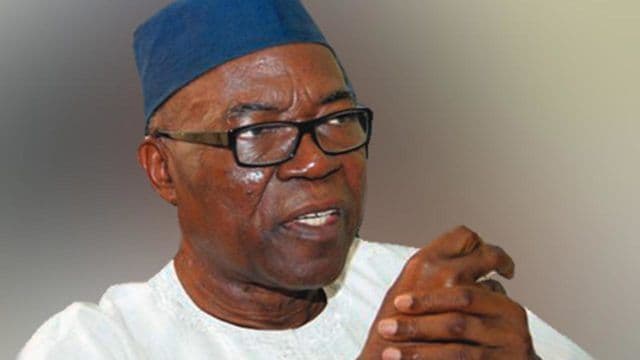
Useni
In October 2022, a Royal Court in Jersey Island, United Kingdom, ordered the forfeiture of nearly £2 million linked to Jeremiah Useni, a retired lieutenant-general who served as minister of the federal capital territory (FCT) and governor of the now defunct Bendel state in the 1980s and 1990s.
Useni, whose middle name is Timbut, first opened an account with ANZ Grindlay’s Bank (now Standard Chartered Bank), Jersey in March 1986 in the name of ‘Mr Tim Shani’.
The initial account opening for ‘Mr Shani’ was done by Selcan Miner, an existing customer of the bank.
At that time, there were no “Know Your Customer” rules, and it was possible to open a numbered account, which replaced the identity of the account holder with a multi-digit number, allowing for greater client confidentiality. Over the next 15 years, money totalling £1.9m was transferred into four accounts held by ‘Mr Shani’ with the bank.
In 2001, the bank wrote to Useni – believing him to be ‘Mr Shani’ – informing him that changes to anti-money laundering legislation in Jersey had resulted in stricter regulations, including the need to have a certified copy of his passport.
In response, six months later, ‘Mr Shani’ requested that the entire balance in his existing accounts be transferred to a Nigerian bank, in which it transpires that Useni was a shareholder.
This request was rejected, and the account was refused permission to operate in February 2003.
Useni made several failed efforts to unfreeze the account and eventually identified himself as the true owner of the Shani accounts in 2007.
He told Standard Chartered that his wealth came from businesses in transport, hospitality, petrol stations, property, farming, and savings, and that he opened a Jersey account for “security.” When pressed for documentation, he gave vague details about his assets but no proof of income from the 1980s and 1990s. He claimed he did not use a false name but a “coded password name” advised by others for his own “protection”.
Jersey’s attorney-general concluded that his use of the alias “Tim Shani” was meant to conceal ownership of assets likely of criminal origin.
In the judgment delivered on May 19, 2022, the Royal Court said: “The Attorney General believes that the Shani accounts were created to hold, hide and conceal bribes or other proceeds of corruption received by Useni during the period he held office”.
“The payments into the Shani accounts were more likely than not for the purposes or on account of exercising political influence over the award of lucrative contracts to foreign and Nigerian companies for the supply of industrial or commercial services in Nigeria,” the court held.
In 2024, the money was returned from Jersey to Nigeria as part of an international anti-corruption agreement.
FROM ‘TIM SHANI’ TO ‘TALI SHANI’
A recent judgment delivered by A UK property tribunal on September 11 has also linked Useni’s name to a property dispute case.
This time, he was said to have purchased the property under another disguise, “Tali Shani”.
The dispute centred on 79 Randall Avenue, a house in northwest London. The property had been claimed by “Ms Tali Shani” on one hand and Mike Ozekhome, a senior advocate of Nigeria, on the other.
Ozekhome said he received the house as a gift from “Mr Tali Shani” in 2021, while lawyers for “Ms Shani” insisted she was the rightful owner.
A witness known as “Mr Tali Shani” had testified in favour of Ozekhome, claiming that he had “Powers of Attorney” over the property and had transferred the property to the respondent (Ozekhome).
Tali Shani asserted ownership of the property from 1993 and claimed he later appointed Jeremiah Useni as his property manager, describing Useni as an “elder friend and business partner.
The tribunal dismissed all claims, ruling that neither “Mr” nor “Ms” Tali Shani existed.
Instead, it found that Useni himself was the true owner, having purchased the house in 1993 under a false name. including “Philips Bincan” and “Tali Shani.”
The 1993 sale documents listed the buyer as “Philips Bincan,” but the property was registered under “Tali Shani.” The court found that Bincan was likely a nominee for Useni, who then arranged for the transfer to the false name “Tali Shani.” The Land Registry accepted this at the time, before stricter ID requirements were introduced.
In testimony given by video before his death, Useni confirmed: “I owned it… I bought the property… before I gave it to someone to run… I paid the deposit… then bit by bit…. I bought it… it is my property.”
The tribunal also drew on evidence from Jersey, noting that Useni had a habit of using “coded” names, including “Tim Shani,” for his financial dealings. The similarity between Tim Shani and Tali Shani was too close to ignore.
Finally, the court held that since Useni is deceased, ownership now rests with whoever obtains probate of his English assets.
The decision will be published, leaving it to the relevant authorities to decide what further action to take.
Useni died on Thursday, January 23, 2025, at the age of 82 after a protracted illness.
THE CHARGE
The federal government has now filed a criminal charge against Ozekhome over alleged forgery and use of false documents in the disputed property case in the United Kingdom. Thecable
More like this