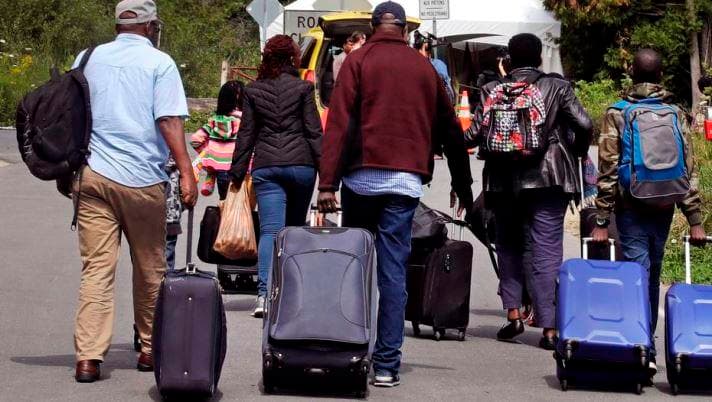
Travails of Nigerian parents struggling to raise children abroad
By Daylight
November 30, 2025
Traveling Nigerians
In this report, BIODUN BUSARI highlights the challenges Nigerian parents face in raising children in the diaspora, where foreign values often clash with African principles. Many who relocate for better opportunities struggle to instil Nigerian discipline, respect, and family structure in their children, while balancing two cultures. In some cases, their disciplinary measures, intended to safeguard their children, can put them at odds with the law
In the dead of night, beneath a sky streaked with flying missiles and the echo of hushed words amid crumbling buildings, while troops strategised to seize territories, ground units patrolled war-torn streets, and wounded soldiers tended to their pain, Dr Olabisi Johnson, a four-month pregnant woman, fled across European borders, her heart pounding with every step, praying she would survive the horrors of the Russian invasion of Ukraine to one day cradle her unborn child.
She and her four friends, in despair, would wish they had not moved to Ukraine for their academics.
The war had turned their dreams and smiles into curses and hisses laden with gloom, as thoughts of her family, husband, children, and mother in the United Kingdom flashed before her.
“I started my studies in Belarus, and when it became difficult to continue, I moved to Ukraine. But everything fell apart again when the war began,” Johnson recalled, marking the beginning of her challenging journey as a parent in the diaspora.
The dream of studying abroad had taken her out of Nigeria in 2011. While most of her family chose the UK, she deliberately set her sights on Eastern Europe, seeking opportunities far from home.
She usually visited her husband in the UK. But when Russian troops turned Ukraine into a battle-scarred country in 2022, reuniting with her husband became her one goal, as border patrols threatened that dream.
After days in the jungle, French border patrols, armed to the teeth, refused to compromise procedures or lower standards despite Johnson’s predicament.
Her protruding tummy should have been leverage to give her safe passage, but it only drew pity from the soldiers after knowing they were escapees from the war-torn nation.
“It’s so difficult for me,” she said, casting her mind back to her ordeal. “Initially, I was happy when we were told that we had reached the French border. We even had Ukrainian residents there.”
However, her happiness was cut short when the French troops said they could not enter without Schengen visas.
“I can’t forget that experience because I almost died in that war in Ukraine. I was pregnant, for God’s sake! We were about five at the border. I showed them my residence in the UK, but they said we couldn’t go without a Schengen visa,” she recounted.
“And I cannot speak French. I can speak Russian very well. I also speak Belarusian fluently. I also speak Ukrainian and Polish. Somehow, French stood between me and crossing over to see my husband.”
The French government was aware of her predicament and ordered that she and her friends be lodged in a nearby hotel. The patrols planned to return them to Ukraine when the war had ceased. However, she went through the rigours of immigration before eventually arriving at her destination.
Pathetic mothering experience
After spending days at the French border, Johnson told Sunday PUNCH that the reunion with her husband in the UK came with a disturbing parenting responsibility.
She gave birth in August 2022; however, the reality of her new environment required financial strength to live with her husband, which they could not afford.
Before giving birth, Johnson, an orthopaedic surgeon, relived the pain of squatting with her mother, realising that it became easier for a camel to pass through the eye of a needle than to live with her husband.
“I was living with my mum when I got to the UK. I decided to stay with her because it became hard for me to live with my husband. We planned to live together as a couple, but his landlady said we had to pay more rent. Imagine the landlady was a Nigerian and had no pity on me,” Johnson narrated.
“The rent was £900 for a box room. A container is even bigger. She said we should add money to the house. She asked for an extra £150 for the rent. I told my husband that the money was too much, that I would stay with my mum.”
When Johnson thought her mother would be her succour during her postpartum days, the old woman, however, left the house the very day she gave birth, kickstarting her travails of nursing a child in the diaspora.
“My mother got a new job,” said the mother of three. “She needed to stay close to her new job. Unfortunately, I had to move out of the accommodation. So I rented a room in a hotel for three months. Then, I went to look for another house.”
Landlords’ council tax burdens
Clarifying why many landlords become hostile toward tenants in their properties, Johnson noted that house owners in England, Wales, and Scotland face financial burdens of paying council tax.
The GOV.UK website describes the council tax as a system of local taxation collected by local authorities on domestic property.
It further states, “This is a tax on domestic property collected by the local authority to pay for local services such as schools, rubbish collection, roads, and street lighting.”
Describing the toll of the council tax on the landlords, who, in turn, transfer their burdens to tenants, Johnson says, “If you have three children and you don’t tell your landlord, they will send you packing when they get to know. They don’t usually accept a father, mother, and three or four children in their houses.”
She explained her ordeal during her early days as a nursing mother in the UK.
“The landlord would tell you that your children would spoil their property or mess up the wall. Most of them will not like to accommodate families because of the council tax. The government puts more council tax based on the number of families in the house. So that’s why they don’t want to pay more council tax.”
Additionally, she stated that the British government is concerned about the welfare of children and will not condone any act that jeopardises their welfare or threatens their health.
This, she explained, was why landlords and landladies tread cautiously in cases which involved underage tenants.
“If I owe my landlord, he can throw me out. But if I’m owing and he throws me out with my children, and I report to the council, he will be scared. I have the right to stay there and raise money until I find somewhere to move to. If I don’t have a child, it’s easy for the landlord to chase me away. If I have a child, the landlord doesn’t have the right to evict me,” Johnson added.
Better life costs extra
When Gisela Esapa left Nigeria for the UK three years ago, she never knew that her dream of giving her children a better life would come at an extra cost, not a financial one alone.
She soon learned that giving her children the best transcends financial burdens; emotional, psychological, and physical resources must also be provided.
“I left Nigeria to create better opportunities for my kids, especially my 14-year-old son with learning disabilities,” she sighed. “I knew relocation was not easy, especially to a far-developed world, but I had to take the step. I knew the lifestyle was completely different, but I had to challenge myself so that my children could learn to integrate better, since the reason for leaving Nigeria was mainly for them.”
As a support worker in Dunstable County, Esapa and her husband worked shifts to raise four children, and nothing must go wrong in securing their lives, even if they were not physically present.
Her experience with her 14-year-old boy, Josh, tested her maternal role in an environment foreign to African-style parenting.
Boy’s burden, mother’s responsibility
“I have a son with a little learning disability. He is my second son. If you don’t interact with him, you won’t notice. If you ask him basic questions, he can answer. But he can’t express himself for long. He is not comfortable with long conversations,” Esapa explained.
She had thought that the school her son was enrolled in would be a solace for him and a relief for her struggles. It was, however, the opposite the day she failed to be there for him for just a few minutes.
“We got a school for him. But it became an issue for them when they noticed a disability in him. It wasn’t a physical disability. He is just a little challenged in terms of learning. They wanted us to be with him every time, but that is not possible. I have to work to earn a living,” she cried.
“There was trouble on a fateful day. My friend had helped me drop him off at school. She would help me with her children because they attend the same school. He was dropped off at the reception, and his teacher was supposed to pick him up. But they insisted someone had to stay with him until the teacher came.”
“My boy is the type who would not sit in one place. He likes looking at cars and people passing. He was in the reception area, looking out through the glass door and smiling. These things are familiar to little children, especially in a new environment. He would just look out, smiling and watching people. This became a burden when the school authorities complained.”
Esapa, working in a British environment, gradually became embroiled in offering special attention to her 14-year-old boy. The attention was not merely care, but a demand from school staff who magnified issues that overwhelmed her.
“There was a day his elder brother left him at school. He forgot to pick him up,” she recounted. “On that day, they closed earlier at 12 noon. By 12:10 p.m., Josh was still wandering in the school. In those 10 minutes, they had called my husband several times. He was busy at work. They had called me too. Unfortunately, I had put my phone on silent because I was sleeping. I had a migraine.”
“They had already bombarded him with questions. They asked him where I was. They asked if I had abandoned him. When I eventually checked my phone, I saw several missed calls from my husband. I didn’t know how I raced to the school.
“When I got there, I couldn’t even recall all the English they unleashed on me. They recommended that I see a social worker, then a clinical officer, and a general practitioner. Everyone was collecting reports, all because a child with a learning disability stayed an extra 10 minutes on the school premises,” she said.
In her struggle to fend for her children and survive shifts, Esapa summoned the courage to confront the authorities at Josh’s school after a friend’s advice.
“A friend told me, ‘You have to speak with confidence,’” Esapa explained. “That was when I faced them at his school. I made a detailed report about his condition. They invited me, and I defended my points. I let them know my child was fine. It was then that they respected my opinions.”
Despite all the challenges, Esapa believes British principles of nurturing children are not entirely bad, though she condemned the overindulgence.
“I won’t say I prefer theirs completely over ours. And I will not say I prefer ours completely over theirs,” she smiled.
“There are things to learn from their side, and things to retain from our culture. In the UK, parents first listen to children before reacting. Back home in Nigeria, we react first before listening. The downside is that they overindulge.”
‘Don’t beat, don’t talk’
A business analyst, Babatunde Adegbindin, pointed out that the burdens of parenting are enormous, and Nigerian parents in the diaspora would need to devise means to train their children properly.
He maintained that adopting unique styles of passing information to children through facial expressions in the British terrain is imperative.
Adegbindin explained that his children may adopt the unconventional lifestyle of disrespecting not only their parents but all adults, while avoiding clashes with British laws that prohibit smacking and harsh words.
“If you have made up your mind to live in a country with so many laws as you find here, you must also be prepared to abide by the rules, so that you don’t fall into trouble,” he said.
“When you are in this kind of country, there are so many restrictions. You can’t beat the children. Even when you talk to them, you can’t talk too much or use harsh words that can affect their mental health or self-esteem.”
Individualistic environment
Adegbindin explained that the African setting, where parents, teachers, and older family members have the moral responsibility to discipline younger ones, is not permissible in the UK. Rather, an individualistic environment is what is obtained in most European and American cultures. This gives children the opportunity to misbehave without restrictions.
He noted, “Africans are used to communal living. But in this country, if you don’t have family, God help you. Punch